Gold
The discovery of gold in the area in 1851 transformed a quiet pastoral district into a place of global significance, reshaping its towns, economy and environment in ways still visible today.
The story begins earlier, on 15 February 1823, when Assistant Surveyor James McBrien recorded traces of gold near the Fish River, opposite Sidmouth Valley near Tarana — the first authenticated reference to gold in the colony. The news was suppressed, however, for fear that convicts and settlers would abandon their work in pursuit of fortune.
Everything changed in 1851. Following the discovery of payable gold at nearby Ophir, rich alluvial deposits were found along the Turon River in June. Within months, thousands of diggers converged on the district. Along the Turon — from its headwaters above Sofala to its junction with the Macquarie River — men dug, panned and sluiced in an extraordinary display of hope and hardship.
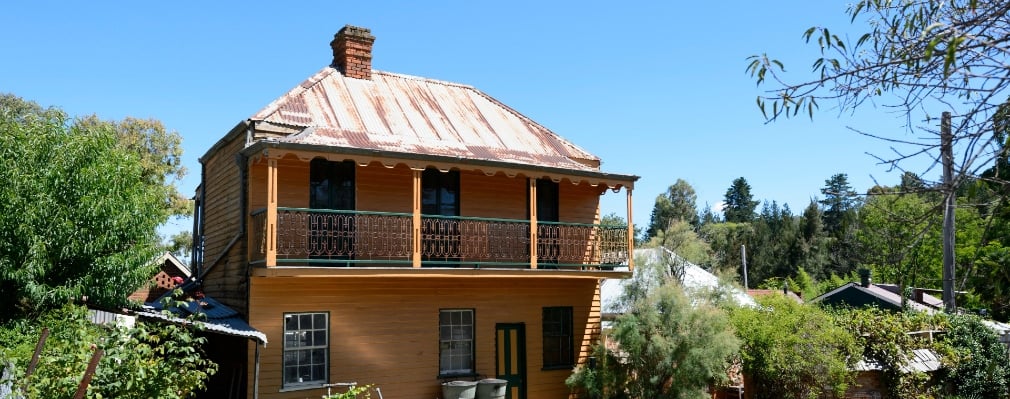
The village of Sofala, established where the Bathurst–Mudgee road crossed the Turon, quickly became the administrative heart of the goldfield. Its Gold Commissioner’s residence, still standing today, is believed to be the oldest surviving gold rush building in New South Wales. Sofala itself proudly claims to be Australia’s oldest surviving gold rush village.
New settlements sprang up across the region as fresh discoveries were made — Wattle Flat along Oakey Creek, Trunkey Creek south of Bathurst, and Tambaroora near Hill End. Early mining focused on alluvial gold found in creek beds and gullies. Horse-powered pug mills, introduced by American diggers, were used to process heavy clay soils. When surface gold dwindled, miners turned to “deep lead” mining, sinking shafts to reach buried streambeds.
By the early 1860s, attention shifted to quartz reef mining. This transition is reflected in the decline of Tambaroora and the dramatic rise of Hill End. In the early 1870s, Hill End flourished as one of the colony’s richest reef-mining centres.
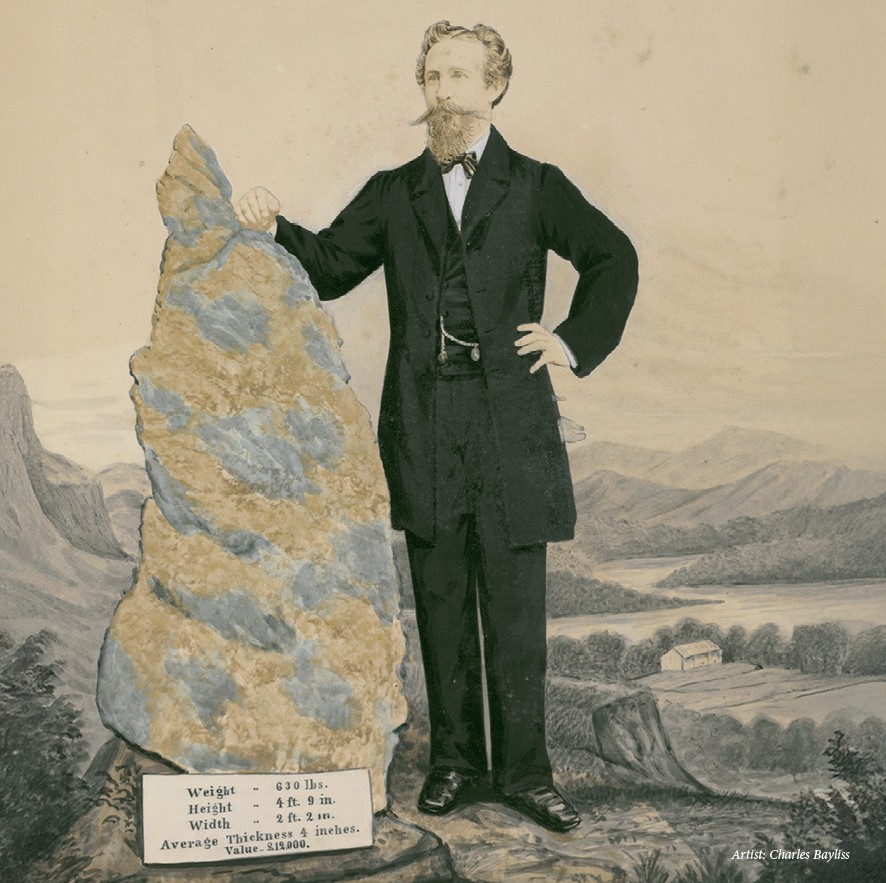
The discovery of the remarkable Holtermann Nugget in 1872 symbolised the immense wealth drawn from Hawkins Hill.
Did you know?
· The Gross Weight (gold + quartz + slate) was 285 Kg, and the weight of gold was 93.2 Kg (3,000 Troy ounces). It measured 144.8 cm high x 66 cm wide x 10.2 cm thick. The gold would be worth about $15 million today (2026)
· Soon after its discovery, the specimen was crushed in a stamper battery and melted down to extract its gold.
For a brief period, Hill End rivalled Bathurst in size and importance. Yet, like many boomtowns, its prosperity was short-lived. By the 1880s, decline had set in, and mining largely ceased by the early twentieth century. Since 1967, Hill End has been preserved as a remarkable open-air gold mining museum.
Life on the goldfields was harsh. Diggers lived in tents or rough huts, endured food shortages and unsafe working conditions, and faced the constant threat of flash floods along the Turon. Water races and dams — remnants of which remain today — were constructed to manage scarce or unpredictable water supplies.
The gold rush also brought cultural exchange and diversity. Experienced miners arrived from California, while thousands of Chinese migrants journeyed on foot from Sydney to the western fields, forming long processions along the road to the Turon. According to reports of the day, local Wiradyuri people were involved in early discoveries.
Find out more: https://www.heatgg.org.au/resources/databases/multiculturalism/chinese/